UX CASE STUDY

UX CASE STUDY

Netflix Mood

Selector

Netflix Mood

Selector

Netflix Mood

Selector

Transforming content discovery from overwhelming to intuitive through emotion-driven recommendations

Transforming content discovery from overwhelming to intuitive through emotion-driven recommendations

Transforming content discovery from overwhelming to intuitive through emotion-driven recommendations

3

3

WEEKS

WEEKS

40

40

PARTICIPANTS

PARTICIPANTS

92%

92%

SATISFACTON

SATISFACTON

01 - PROBLEM

The paradox of too much choice

The paradox of too much choice

The paradox of too much choice

Netflix's content library is a strength that creates a real friction point:

Users spend significant time browsing without finding something that matches how they feel in the moment. This browsing fatigue often ends in abandonment, not because the content isn't there, but because the discovery experience doesn't account for emotional context.


Netflix's existing algorithm is history-based. It surfaces what you've liked before, not what you're in the mood for right now. Those are different questions, and the current UI conflates them.

Netflix's content library is a strength that creates a real friction point:

Users spend significant time browsing without finding something that matches how they feel in the moment. This browsing fatigue often ends in abandonment, not because the content isn't there, but because the discovery experience doesn't account for emotional context.


Netflix's existing algorithm is history-based. It surfaces what you've liked before, not what you're in the mood for right now. Those are different questions, and the current UI conflates them.

DESIGN QUESTION:

How might we help users find content that matches their current mood — without adding more cognitive load to an already overwhelming experience?

DESIGN QUESTION:

How might we help users find content that matches their current mood — without adding more cognitive load to an already overwhelming experience?

DESIGN QUESTION:

How might we help users find content that matches their current mood — without adding more cognitive load to an already overwhelming experience?

02 - COMPETITIVE CONTEXT

How others approach this problem

How others approach this problem

How others approach this problem

Before designing anything, I looked at how other platforms handle mood or context-based discovery.

Before designing anything, I looked at how other platforms handle mood or context-based discovery.

Spotify

Spotify

Strong precedent

Mood-based playlists ("Focus", "Chill", "Energy Boost")

Users don't search - they browse by feeling.

Netflix Today

Netflix Today

Gap identified

History- and popularity-based rows

"Because you watched X" is the primary control signal. Mood is not a first-class input.

Apple TV+

Apple TV+

Same Gap

Curated editorial collections

Staff picked themes, but no user-driven mood input.

The pattern across competitors: Mood works well as a discovery input, but none of the major video platforms treat it as a primary entry point.

The pattern across competitors: Mood works well as a discovery input, but none of the major video platforms treat it as a primary entry point.

03 - RESEARCH

Survey Findings

Survey Findings

Survey Findings

I ran a Google Form survey with 40 participants (ages 18–45, all active Netflix users) to pressure-test the problem hypothesis before designing anything.

I ran a Google Form survey with 40 participants (ages 18–45, all active Netflix users) to pressure-test the problem hypothesis before designing anything.

82%

Spend 10+ minutes deciding what to watch

per session.

74%

Say mood directly

shapes what they

want to watch.

67%

Have wanted mood-based suggestions while browsing

~40%

Left Netflix without watching due

to indecision.

82%

Spend 10+ minutes deciding what to watch per session.

74%

Say mood directly shapes what they want to watch

67%

Have wanted mood-based suggestions while browsing

~40%

Left Netflix without watching due to indecision.

82%

Spend 10+ minutes deciding what to watch per session.

74%

Say mood directly shapes what they want to watch

67%

Have wanted mood-based suggestions while browsing

~40%

Left Netflix without watching due to indecision.

Selected verbatim responses

Selected verbatim responses

"I scroll for ages, nothing feels right, and then I just give up and go on my phone instead."

— Survey respondent, 27

"I scroll for ages, nothing feels right, and then I just give up and go on my phone instead."

— Survey respondent, 27

"I spend more time deciding than actually watching sometimes."

— Survey respondent, 22

"I spend more time deciding than actually watching sometimes."

— Survey respondent, 22

Research limitation: The sample was convenience-based and self-selected, so findings are directional rather than statistically representative.

Research limitation: The sample was convenience-based and self-selected, so findings are directional rather than statistically representative.

Research limitation: The sample was convenience-based and self-selected, so findings are directional rather than statistically representative.

04 - IDEATION

What I explored — and what I cut

What I explored — and what I cut

What I explored — and what I cut

I used FigJam to map out several directions before committing to any of them.

Mood wheel / sliders

Mood wheel / sliders

Visually interesting but created a new problem: users had to think too hard before getting any value. Cognitive load test failed.

Visually interesting but created a new problem: users had to think too hard before getting any value. Cognitive load test failed.

Discarded

Multi-step Questionnaire

Felt like a survey, not a feature. 3+ steps before a result was too high a barrier for something that should feel effortless.

Felt like a survey, not a feature. 3+ steps before a result was too high a barrier for something that should feel effortless.

Discarded

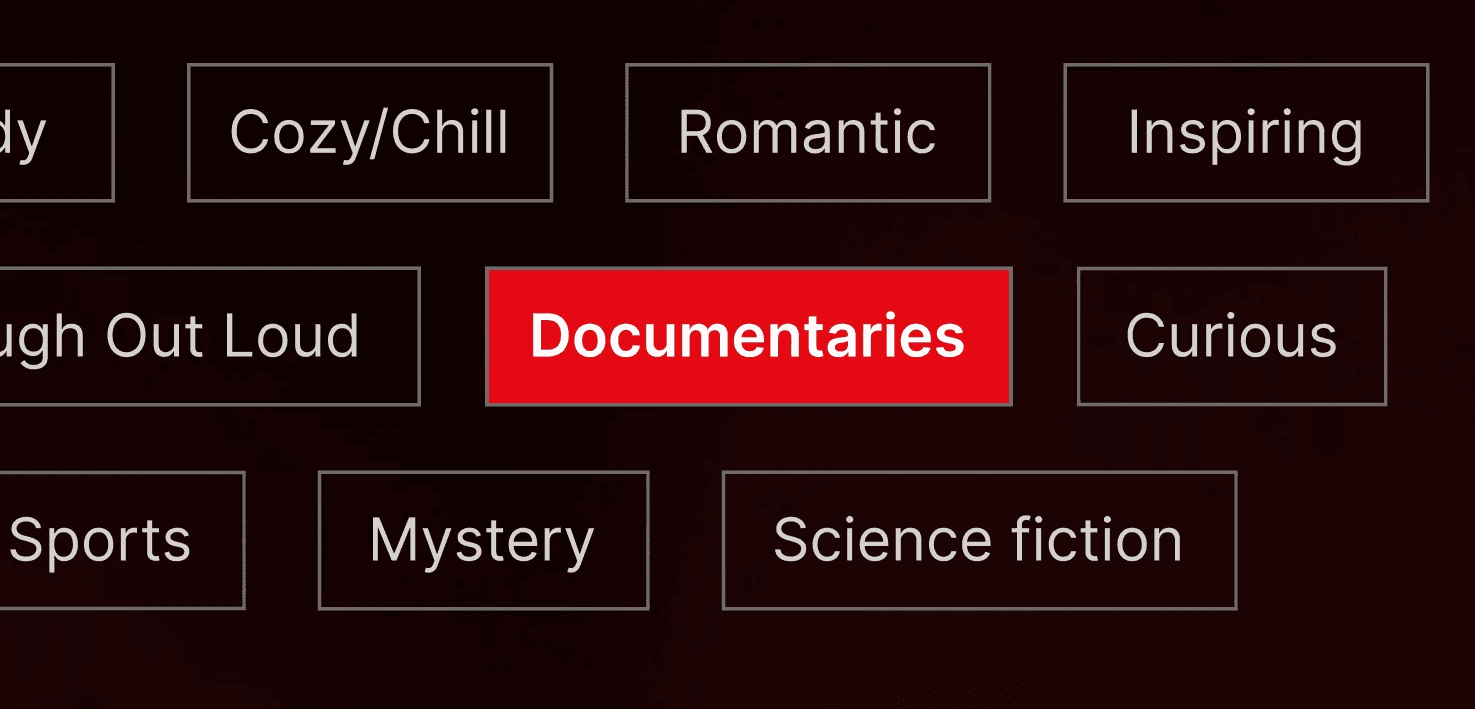
Tappable mood tags

One tap to start, instant feedback. Works with Netflix's existing visual language. Lowest friction path to a result.

One tap to start, instant feedback. Works with Netflix's existing visual language. Lowest friction path to a result.

Chosen

Single recommendation output

Showing a list reintroduces choice paralysis. One curated result with a "try another" escape valve solved this.

Showing a list reintroduces choice paralysis. One curated result with a "try another" escape valve solved this.

Chosen

DESIGN OBJECTIVES

DESIGN OBJECTIVES

  • Under 2 min to a recommendation

  • Under 2 min to a recommendation

  • Zero added cognitive load

  • Zero added cognitive load

  • Feels native to Netflix UI

  • Feels native to Netflix UI

  • Easy to adjust or undo

  • Easy to adjust or undo

The solution

INTRODUCING MOOD PICKS

INTRODUCING MOOD PICKS

A mood-based recommendation feature that helps users discover content aligned with their current emotional state. By selecting mood tags, users receive personalized suggestions that match how they feel—turning choice overload into an enjoyable, intuitive experience.

A mood-based recommendation feature that helps users discover content aligned with their current emotional state. By selecting mood tags, users receive personalized suggestions that match how they feel—turning choice overload into an enjoyable, intuitive experience.

05 - SOLUTION

Mood Picks — a three-step flow

Mood Picks — a three-step flow

Mood Picks — a three-step flow

I used FigJam to map out several directions before committing to any of them.

I used FigJam to map out several directions before committing to any of them.

01

01

Access

Via "Mood Picks" in the

navigation or a "Need Ideas?" button on the home screen.

Via "Mood Picks" in the

navigation or a "Need Ideas?" button on the home screen.

02

02

Select Mood

Select Mood

Tap pre-defined mood tags or type your own. Toggle between Movies and TV Shows.

Tap pre-defined mood tags or type your own. Toggle between Movies and TV Shows.

03

03

Get a pick

One curated recommendation. Play now, get more info, or try another.

One curated recommendation. Play now, get more info, or try another.

Designing the experience

Hover Element

Hover Element

Hover Element

Matched Netflix's signature red-hover microinteraction so the feature feels native, not bolted on.

Matched Netflix's signature red-hover microinteraction so the feature feels native, not bolted on.

Matched Netflix's signature red-hover microinteraction so the feature feels native, not bolted on.

Mood Tag Control

Mood Tag Control

Mood Tag Control

Users can edit Mood tags - add or remove with a single tap.

Users can edit Mood tags - add or remove with a single tap.

Users can edit Mood tags - add or remove with a single tap.

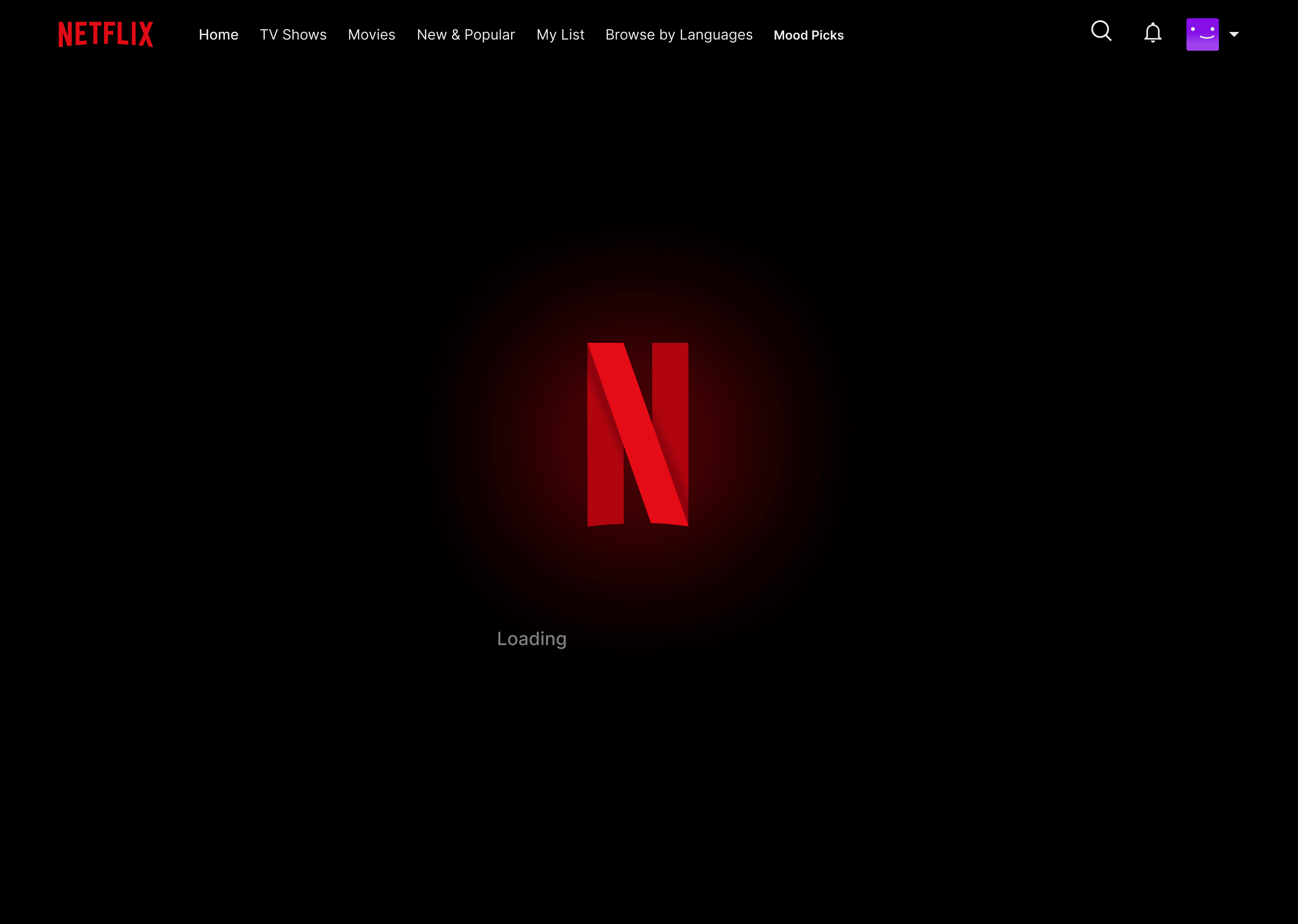
Loading Animation

Loading Animation

Loading Animation

Loading state uses the Netflix 'N' with a subtle zoom-in/zoom-out glow animation — on-brand.

Loading state uses the Netflix 'N' with a subtle zoom-in/zoom-out glow animation, on-brand.

Designs

Designs

Designs

Home Page

To use the content recommendation feature, users can click "Mood Picks" in the top menu. Or click the "Need Ideas" button.

To use the content recommendation feature, users can click "Mood Picks" in the top menu. Or click the "Need Ideas" button.

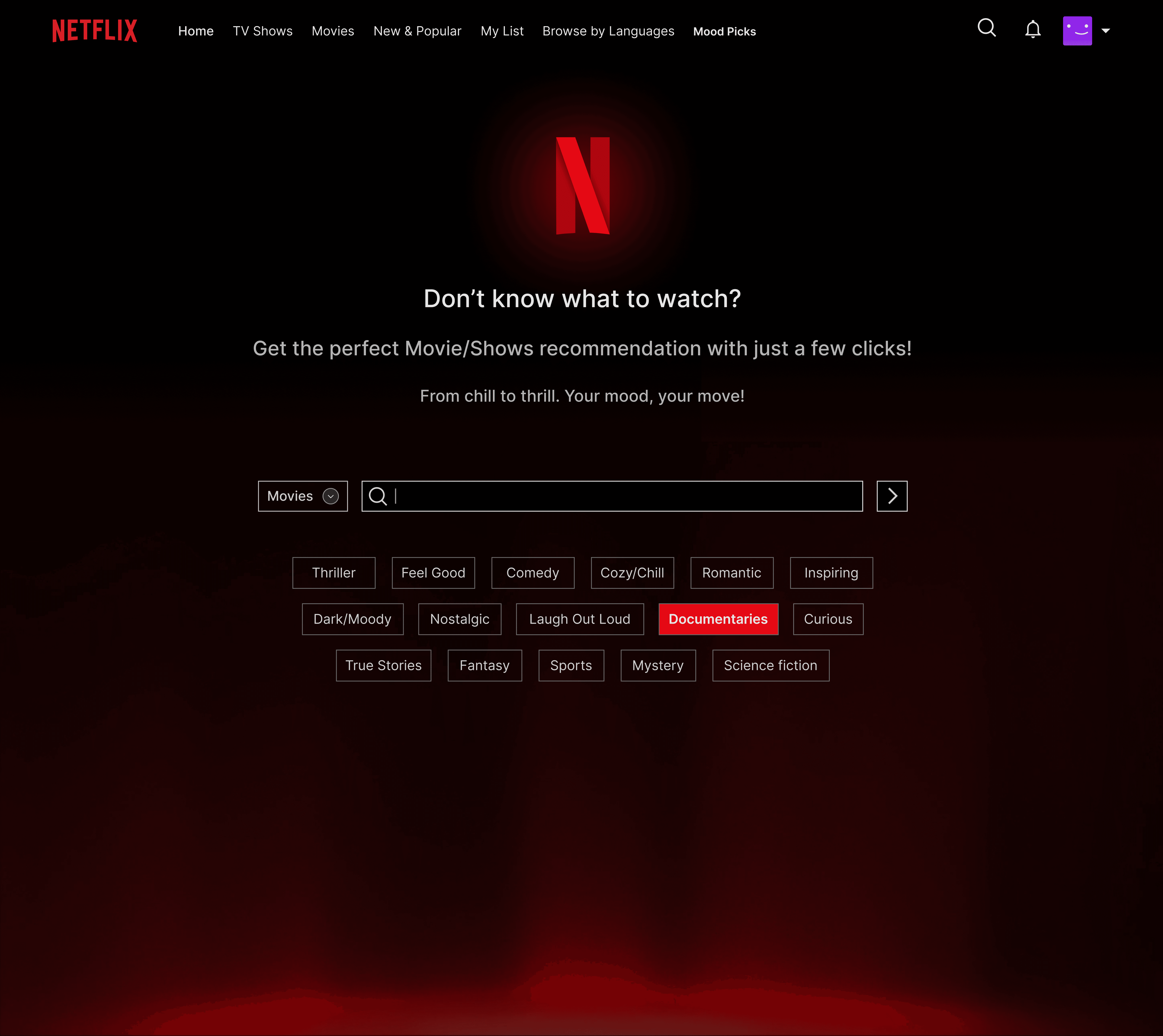
Mood Selection Page

Mood Selection Page

The users can choose the tags they like or type in what they want to watch. Users can also choose between Movies/TV Shows.

Mood Selection Page

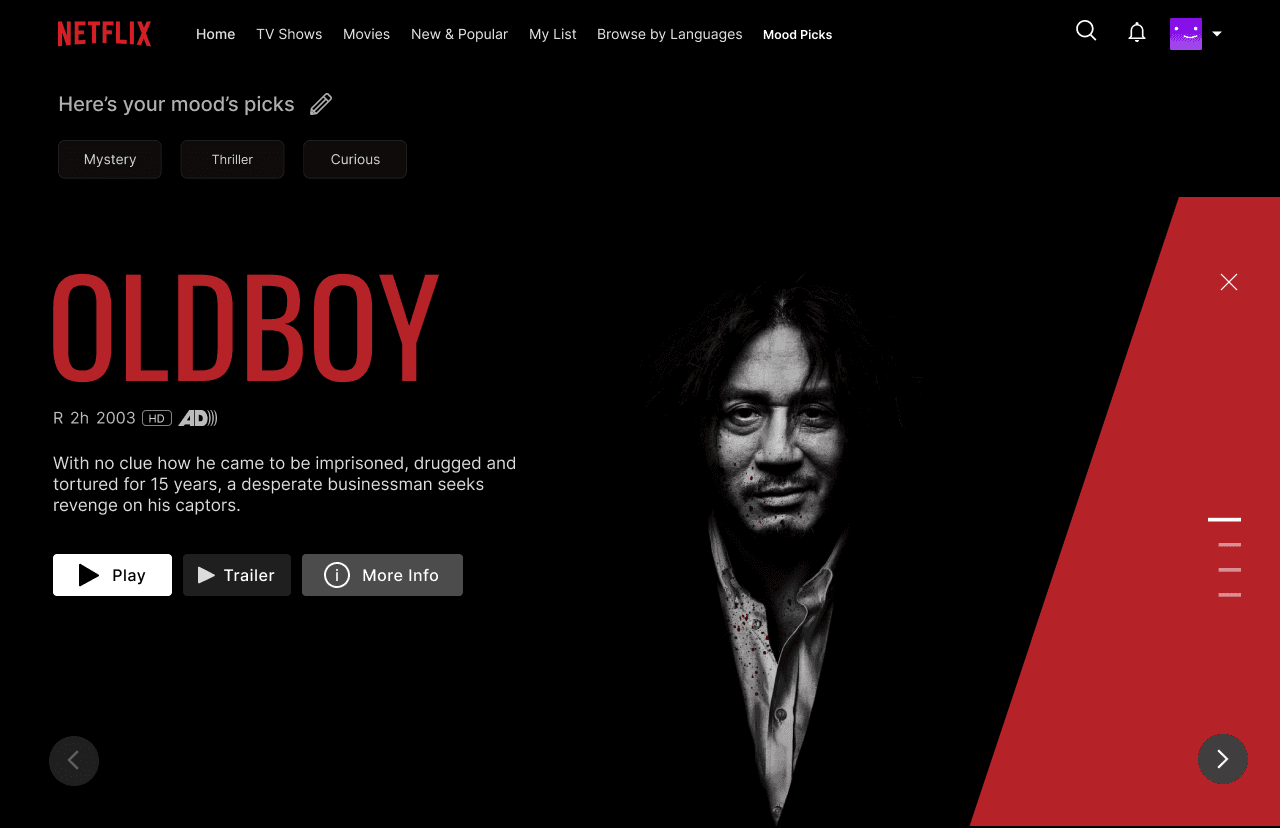
Recommendation Page

Displays a curated title (e.g., Oldboy) with quick options: Play Now, More Info, or Try Another.

06 - TESTING

Usability testing — what worked, what didn't

Usability testing — what worked, what didn't

Usability testing — what worked, what didn't

I ran moderated usability tests with 8 participants using a think-aloud protocol.

92%

Said the experience felt more personal than browsing by genre.

88%

Said they'd use this regularly if Netflix launched it.

6/8

Completed the full flow without any prompting.

92%

Said the experience felt more personal than browsing by genre.

88%

Said they'd use this regularly if Netflix launched it.

6/8

Completed the full flow without any prompting.

92%

Said the experience felt more personal than browsing by genre.

88%

Said they'd use this regularly if Netflix launched it.

6/8

Completed the full flow without any prompting.

07 - REFLECTION

Mood Picks — a three-step flow

Mood Picks — a three-step flow

Mood Picks — a three-step flow

The strongest design instinct I developed on this project: resist the urge to add. Every complex idea I explored failed because it asked users to do work before they got value. The simplest version, tap a feeling, get a result — was also the one that tested best.


If I were to continue this: I'd run structured interviews to explore edge cases (users who can't name their mood, users who want to deliberately break their pattern), test whether the single-recommendation format holds up over repeated use as novelty fades, and explore how mood data could feed back into Netflix's broader recommendation engine without feeling intrusive.


The biggest open question is what happens at session 10, not session 1. That's the research I didn't get to do in 3 weeks.

Self-initiated concept project. No affiliation with Netflix.

© 2025 Priyadharshini Gopalakrishnan | Designer | priya.gops12@gmail.com

© 2025 Priyadharshini Gopalakrishnan | Designer | priya.gops12@gmail.com