LunaFlow: Cycle-aware, accessible fitness — designed in 24 hours.
- Role
- User Research, UX Design, Prototyping
- Timeline
- 24-hour hackathon
- Event
- WiCHacks ’24 · RIT
- Type
- Group project
Project at a glance
Problem
Menstruating individuals want to stay active, but generic fitness apps don’t adapt to cramps, fatigue, or hormonal change — and rarely support hard-of-hearing users.
Solution
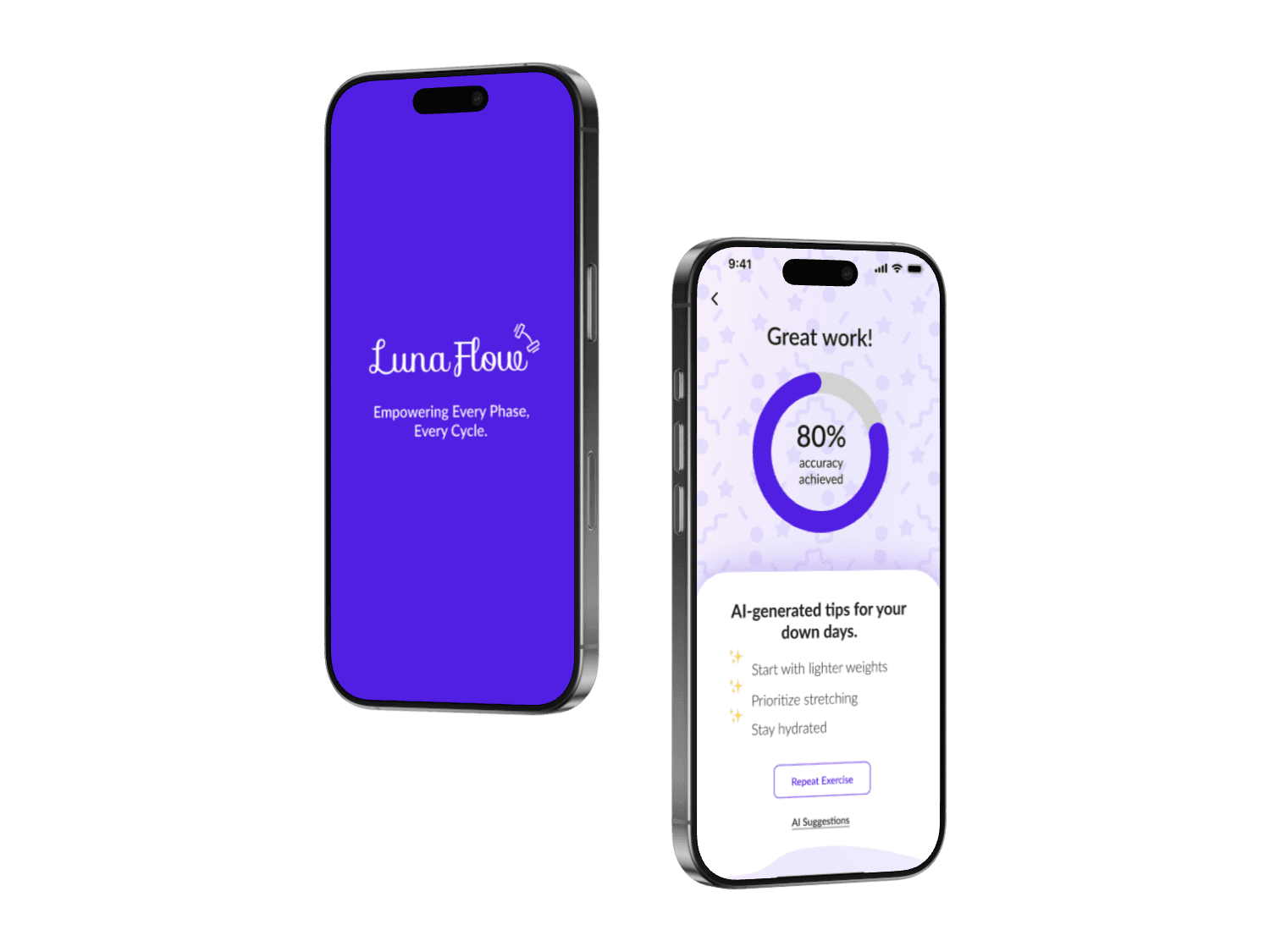
A fitness app combining cycle tracking with adaptive workouts, AR posture scanning, an ASL guidance mode, and AI-generated tips.
Impact
Won “Best Accessible UI” and “Fan Favorite” at WiCHacks ’24 for its inclusive, user-centred design.
- Best Accessible UI
- Winner
- Fan Favorite
- Winner
- Research to prototype
- 24h
01 — Project focus
A pivot grounded in research and ethics
LunaFlow helps people stay active and care for their bodies through every phase of the menstrual cycle.
Initial idea
Pivoted away- A fully accessible workout app for people with all disabilities
- Impractical to design and validate in 24 hours
- Ethically risky without extensive user studies
The pivot
Built- Menstrual wellness fitness: cycle tracking + adaptive workouts
- A combination missing from the market
- Accessibility kept core: AR posture + ASL mode
Why we pivoted
Research shows exercise reduces menstrual pain — and a quick survey at the hackathon found almost every woman experienced cramps and struggled to find an app combining fitness and period care.
02 — Research
Fast research, clear gaps
- Goal: understand how users manage workouts during their cycle.
- Goal: identify accessibility barriers and tone-of-voice pain points in existing apps.
- Goal: validate whether AR and AI can improve safety and confidence.
Desk research
Research papers
Confirmed exercise during menstruation can ease pain and improve wellbeing.
Survey & interviews
Hackathon participants
Nearly all reported moderate to severe cramps; many felt unsupported by generic apps.
Competitive audit
Leading apps
Compared features and accessibility across cycle trackers and fitness apps.
| Gap identified | Design response |
|---|---|
| No app combined cycle tracking and workouts | Cycle-aware workout plans |
| No adaptation for pain, fatigue, or hormones | Energy- and pain-based daily adjustments |
| Little support for hard-of-hearing users | ASL guided video mode |
03 — Ideation
From sketches to a calm, readable system
I sketched the core flows, prioritising the shortest path to a personalised, safe workout.
- Cycle-aware onboarding
- Adaptive daily workout
- AR posture scan
- Community tips
Layout
Minimal card-based UI
Soft, calming palettes to reduce stress; micro-interactions for delight.
Colour
#5C1DE6 · #DDD8FE · #000 · #F5F5F5
WCAG-compliant pairings with contrasting text for readability.
Type
Lato, never under 12pt
Clean and legible, with a consistent hierarchy of large headings.
04 — Designs
Four parts, one inclusive experience
- 1
Inclusive onboarding
Users share preferred pronouns, fitness goal, fitness level, and workout location.
- 2
Cycle-based plan
Users enter period dates and get a personalised workout plan for each phase.
- 3
AR posture + ASL mode
Live posture detection corrects form; ASL mode gives guided video for users with hearing difficulties.
- 4
AI tips & Aurora
AI-generated feedback based on performance, plus Aurora — a virtual assistant for tailored guidance.
05 — Outcome & reflection
Inclusivity means understanding overlooked needs
- Awards: Best Accessible UI & Fan Favorite
- 2
- From pivot to working prototype
- 24h
Reflection
LunaFlow taught me that inclusivity isn’t only about accessibility features — it’s about truly understanding overlooked needs, and having the discipline to scope responsibly.
- Next: deeper research with diverse groups, including people with PCOS and endometriosis.
- Next: refine AR scanning accuracy through testing.
- Next: stronger audio and visual accessibility — ASL videos and voice commands.
- Next: cycle-based dietary recommendations.